Beef Prices: How High is High Enough?

Patrick Linnell, CattleFax, July 2025 (data & opinions were created by Cattlefax for the Beef Checkoff for education purposes)
stylized beef packaging

"Record prices amid larger supplies doesn't happen without demand strength. There is a big picture demand story, as well as important details worthy of closer discussion."

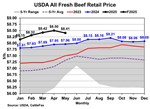
Prices at all levels of the beef and cattle supply chain have moved into new records in 2025. At the consumer level, the question of how high beef prices can be sustained has been a recurring question. Yet, prices have kept moving higher with prices at retail averaging 6% above year-ago through May. (USDA ERS) While few signs suggest prices are likely to move lower, there is evidence that prices may run into more consumer resistance to further increases at these levels, at least for now.

The record retail beef prices have occurred despite overall U.S. net beef supplies that are on pace to be 0.3 pounds above year-ago in 2025 and the largest since 2010 at a calculated 59.3 pounds per capita. (USDA, CattleFax) Record prices amid larger supplies doesn’t happen without demand strength. There is a big picture demand story, as well as important details worthy of closer discussion. 
At a macro level, the broader economic landscape has on an overall positive trajectory, despite elevated uncertainty and challenges in some spots. Wage growth outpacing inflation and low unemployment rates have continued to support consumer spending in general and for beef specifically. There are obviously multiple headwinds that will need to be monitored. Consumer debt levels are high and sentiment has faced a rocky road so far in 2025. However, these issues have yet to slow down consumer spending in total, even as many consumers have become more cost-conscious in their spending habits.  

Historically, a cost-conscious consumer would be a significant headwind to beef, however, a couple factors appear to have prevented much beef demand erosion to this point. First, is the versatility of beef between the food service space and retail. As cumulative inflation at the restaurant space has shifted consumers towards retail, beef has been a welcome item in grocery carts, whether as a staple or a higher-end addition to the at-home dining experience.

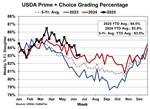
The strong quality grade mix has supported demand for middle meats, regardless of the shifts between restaurants and retail. With Prime, Choice, and upper 2/3rd Choice grade running at record strong levels, the quality mix in front of consumers favors a quality eating experience. Even as quality grade percentages have been running strong, the decline in fed slaughter numbers in total has still resulted in 250,000 fewer Prime and Choice-grading carcasses compared to last year. (USDA AMS) Alongside resilient demand for high quality beef, this decline in carcass counts has been especially supportive to piece count-driven middle meat markets. 
Still, some trade-down has been noted within the beef complex, as some segments of consumers have started to show resistance to higher priced items. This has favored ground beef demand as a lower-priced option. Ground beef prices were up 16.2% from year-ago levels in May, while overall retail beef prices were up 5.6%. (USDA ERS) Domestic ground beef supplies have been limited by sharply lower cow and bull slaughter rates as both beef and dairy producers work to maintain numbers after herd reductions in recent years. Much of the decrease in domestic non-fed beef production has been made up for in tonnage with record beef imports. (USDA ERS) At this point, the record imports have been the result of record beef prices, rather than preventing them. Especially for ground beef, the popularity and trade-down within the beef complex have nonetheless driven prices to record levels. 

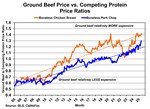
While the beef-specific and macro-level economic environment have boosted beef prices to current levels, there are signs of more consumer resistance from here. The trade-down effect within the beef complex has been noted for some time as the lower priced items have found more upside than higher priced items. However, this appears to be stronger as evidenced by the USDA all-fresh retail beef price moving $0.09 lower in May from April, at time period when seasonally strong beef demand typically results in a higher monthly print. (USDA ERS, CattleFax) Still, beef has continued to build larger price premiums to pork and poultry – evidence that the consumer has still not wanted to trade away to other, cheaper protein options. With slaughter numbers slated to remain tight for the next couple years based on CattleFax projections, prices are not likely to see much downside, barring a significant recession. However, further price increases may be more limited going forward. 
  1. CattleFax. Long Term Outlook. December 2024. https://www.cattlefax.com/#!/news-landing/long-term/long-term-outlook---winter-2024
  2. CattleFax. CattleFax Update. Various report dates. https://www.cattlefax.com/#!/listing-page/update
  3. United States Department of Agriculture, Agricultural Marketing Service (USDA AMS). Actual Slaughter Under Federal Inspection. Various report dates. https://www.ams.usda.gov/mnreports/ams_3658.pdf
  4. United States Department of Agriculture, Agricultural Marketing Service (USDA AMS). Beef, Lamb, and Veal Grading Dashboard. https://publicdashboards.dl.usda.gov/t/MRP_PUB/views/LPMeatGradingDashboard/AMSLPLandingPage
  5. United States Department of Agriculture, Economic Research Service (USDA ERS). Meat Price Spreads. https://www.ers.usda.gov/data-products/meat-price-spreads
  6. United States Department of Agriculture, Economic Research Service (USDA ERS). Meat Supply and Disappearance. https://www.ers.usda.gov/data-products/livestock-and-meat-domestic-data