
Signs of Turning Cattle Cycle
Patrick Linnell, Cattlefax | January 2026 (Data & opinions were created by Cattlefax for the beef checkoff for education purposes)
"The underlying rhythm of tight supplies, strong demand, and gradual herd rebuilding suggests profitability will return to the cow-calf sector and set the stage for renewed expansion into 2027 and beyond."
The U.S. beef and cattle markets are entering a pivotal phase in the cattle cycle as prices find cyclical peaks and supplies turn towards a gradual recovery. Historically, cyclical price peaks come before production lows by six to twelve months, and this cycle appears no different. Tight cattle inventories and exceptional beef demand defined 2025, and while these fundamentals remain positive, the dynamics of supply rebuilding and demand moderation will shape the outlook for 2026 and beyond.
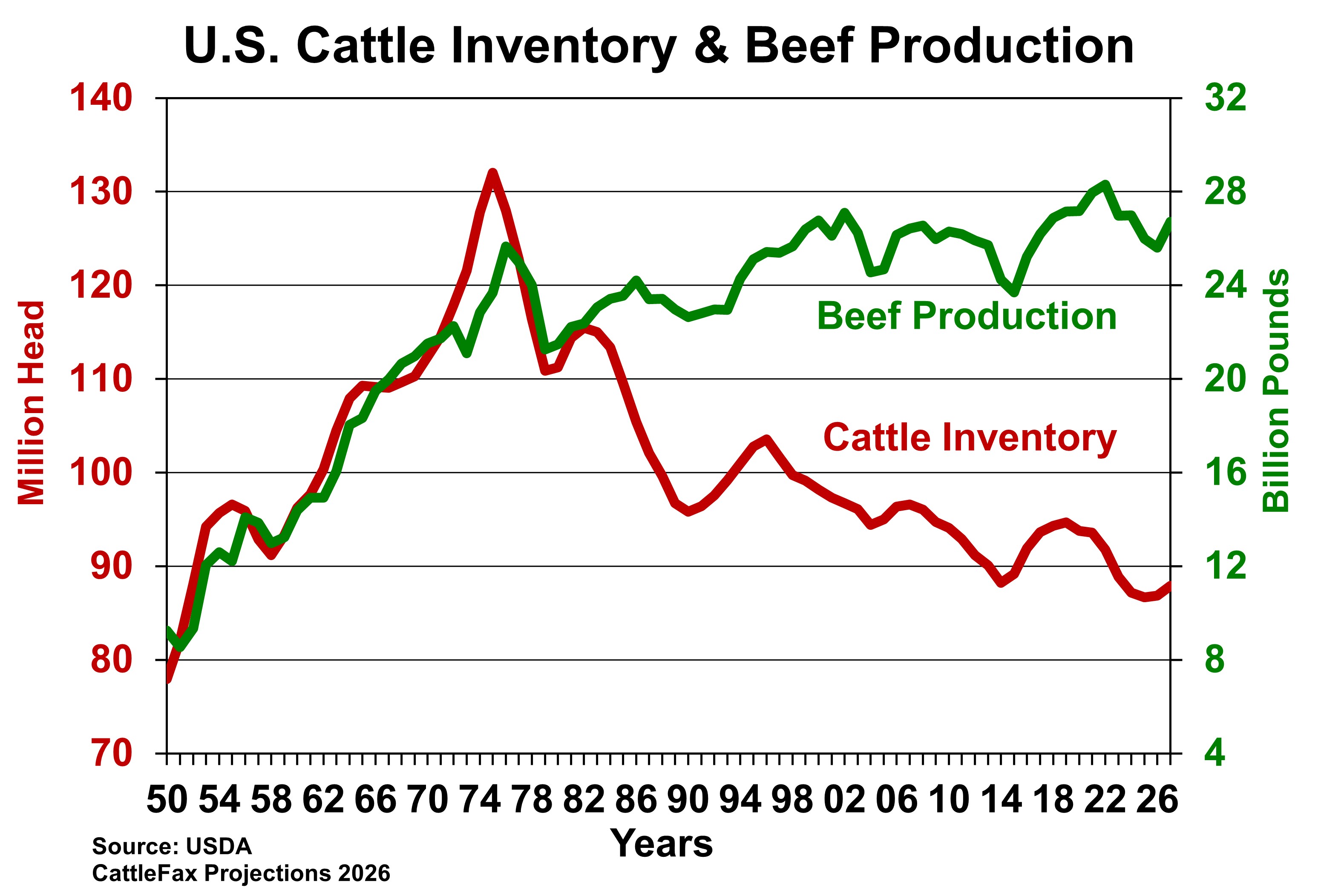
On the supply side, the long-anticipated herd expansion is finally underway, albeit at a slower pace than previous cycles. After six consecutive years of contraction, the beef cow herd is expected to begin 2026 about 150,000 head larger, near 28 million. Low culling rates and modest heifer retention signal the start of rebuilding, but structural headwinds—high input costs, aging producer demographics, and land-use competition—will temper aggressive growth. The dramatic tightening of feeder supplies seen in the last cycle is unlikely to repeat. Meanwhile, dairy cow numbers are projected to start the year above 9.5 million, the largest since 1993, supported by beef-on-dairy adoption that has added roughly one million head to feeder supplies in recent years. However, this contribution is expected to flatten going forward.
The 2025 calf crop likely marked the cycle low, but with only a slight increase forecast for 2026. Feeder cattle outside feedyards will remain historically tight, and feedyard inventories are projected to start the year down 400,000 head from 2025. Placements will be constrained by limited calf availability, modest heifer retention, and the continued absence of Mexican feeder imports—a wildcard that could shift the supply picture dramatically once the border reopens. Current expectations are for a phased reopening sometime in 2026, potentially adding 1.2 million head annually. Until then, fed cattle slaughter will remain tight, falling another 600,000 head in 2026 after a 1.4 million head drop in 2025. Carcass weights are forecast five pounds larger following an increase of over 50-lbs. over the prior two years. Cow slaughter will remain tight with a slight decline in beef cows offsetting a small increase in dairy cows. In total, beef production is forecast to contract 2% in 2026 following a 3.5% decline in 2025.
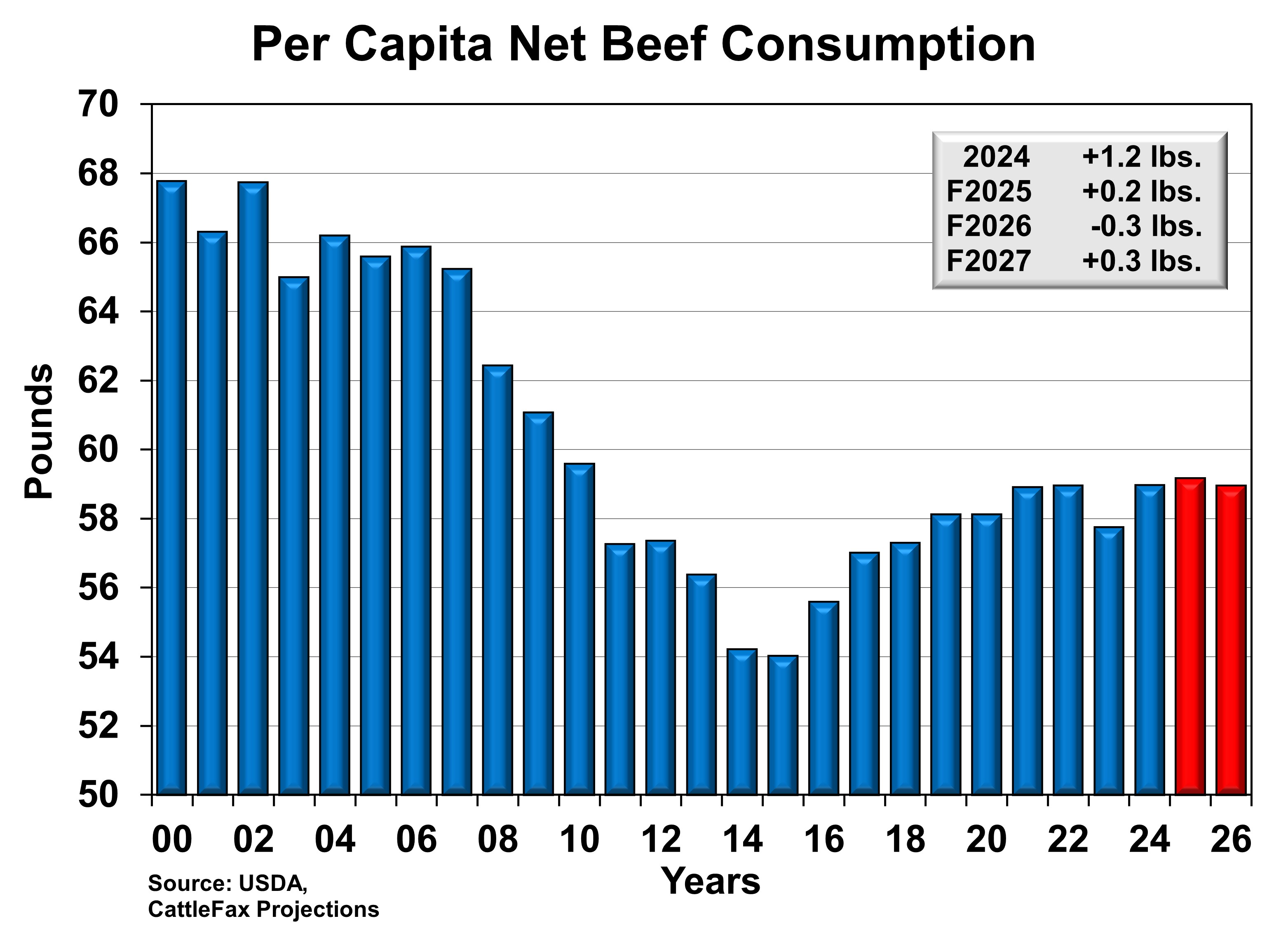
Despite these supply constraints, per-capita beef availability remains near 59 pounds—historically strong—thanks to heavier carcass weights and elevated imports. Imports of lean beef will stay robust to meet ground beef demand as U.S. lean beef production remains tight. Exports for U.S. beef will remain strong but will be limited by tight domestic production. This balance underscores the resilience of consumer demand, which delivered record performance in 2025. Retail beef prices surged past $9 per pound, and the composite cutout averaged $357/cwt., briefly topping $400, reflecting the culmination of a multi-year demand growth phase that began in 2020.
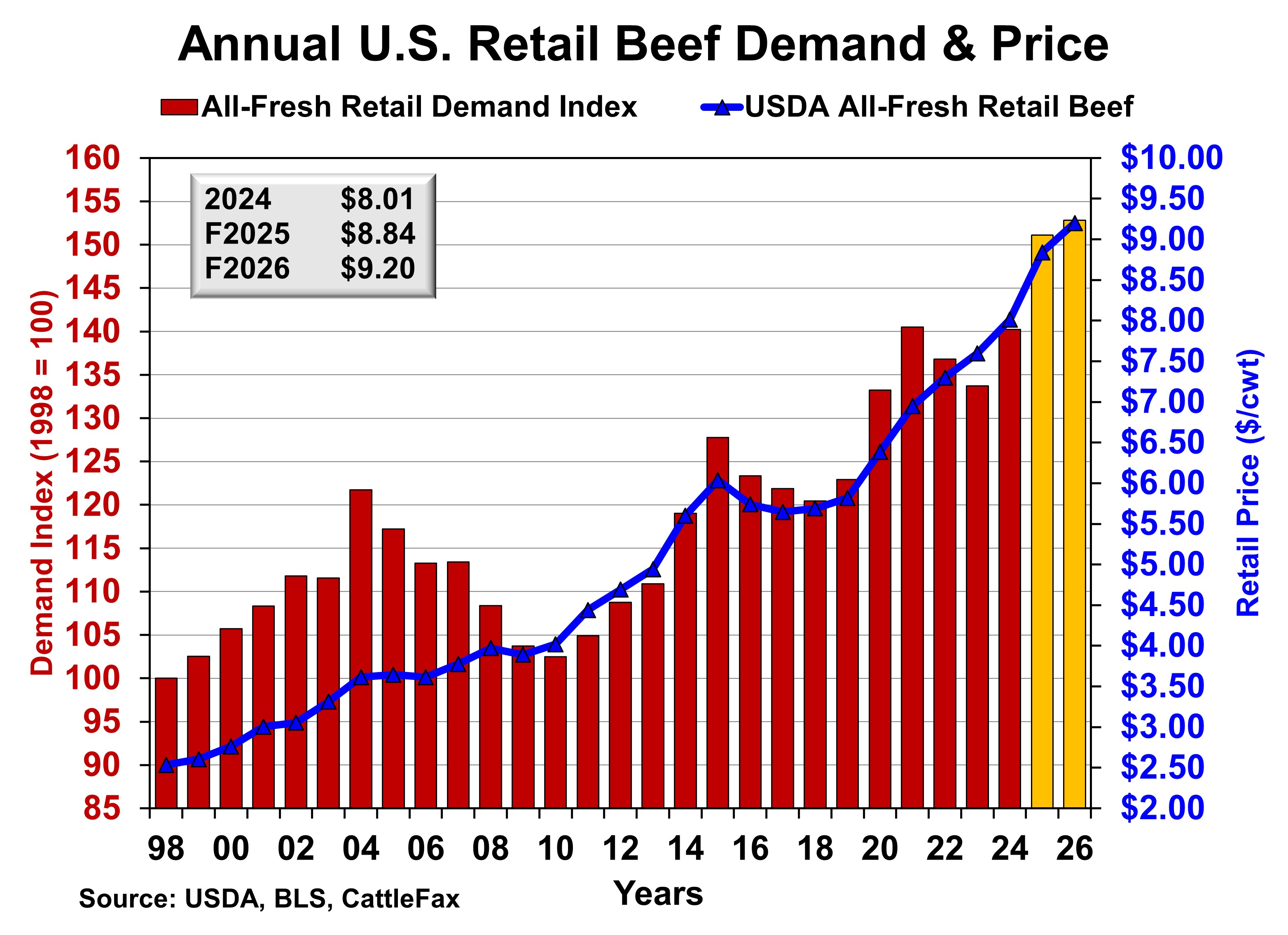
Looking ahead, 2026 is expected to usher in a period of demand consolidation after the rapid growth of recent years. Retail beef prices should stabilize between $9.00 and $9.50 per pound, while the composite cutout averages near $350/cwt. The first half of the year will likely see continued strength as tight supplies support wholesale values, but moderation is anticipated later as affordability pressures mount. Historical patterns suggest this pause is cyclical: demand growth phases typically last five to six years, followed by consolidation periods of similar length.
Even so, demand fundamentals remain historically strong. Quality improvements have transformed beef’s competitive position, with 84% of fed cattle grading Choice or higher and 12% achieving Prime in 2025. This quality shift, combined with cultural emphasis on protein, positions beef favorably with consumers. For now, volatility may increase as markets digest the cyclical transition, but the underlying rhythm of tight supplies, strong demand, and gradual herd rebuilding suggests profitability will return to the cow-calf sector and set the stage for renewed expansion into 2027 and beyond.
Sources:
CattleFax. Long Term Outlook. December 2025. https://www.cattlefax.com/#!/news-landing/long-term/long-term-outlook---winter-2025
CattleFax. CattleFax Update. Various report dates. https://www.cattlefax.com/#!/listing-page/update
United States Department of Agriculture, National Agricultural Statistics Service (USDA NASS). Livestock Slaughter Annual Summary. April 23, 2025. https://esmis.nal.usda.gov/sites/default/release-files/r207tp32d/k930dv029/1v53mt52h/lsan0425.pdf
United States Department of Agriculture, National Agricultural Statistics Service (USDA NASS). Livestock Slaughter. Various report dates. https://usda.library.cornell.edu/concern/publications/rx913p88g
United States Department of Agriculture, Agricultural Marketing Service (USDA AMS). Actual Slaughter Under Federal Inspection. Various report dates. https://www.ams.usda.gov/mnreports/ams_3658.pdf