What/Who can get New World Screwworm?
- NWS can affect all mammals, including humans and household pets, and rarely birds.3
- NWS is most common in livestock.3
- This pest can infest a wide variety of wounds, from tick bites to cuts and dehorning or branding wounds.3
- Infestations are very common in the navels of newborn animals and the genital regions of their mothers.3
Infestation: What happens?
- Screwworm infestations begin when a female fly lays eggs on a wound or orifice of a live warm-blooded animal.4
- Eggs hatch into larvae that burrow into the wound to feed on the living flesh.4
- After about 7 days of feeding, larvae drop to the ground, burrow into the soil and pupate.4
- The pupa is a transitional stage from larva to adult fly.4
- The adult screwworm fly emerges from the soil after 7–54 days depending on temperature and humidity.4
- Female flies mate after 3 days, and males can mate within 24 hours of maturation.4
- One female can lay up to 3,000 eggs in her lifespan.4
- Female flies are attracted to the odor of a wound or opening such as the nasal or eye openings, umbilicus of a newborn, or genitalia.4
- Wounds as small as a tick bite may attract a female to feed.4
Infestation: What do I Look for?
- Look for the following signs in warm-blooded animals (including pets and birds):3
- Irritated behavior
- Head shaking
- The smell of decay
- Presence of maggots in a wound
- Egg masses may be around or in the wound; larvae may be visible by the third day of infestation.4
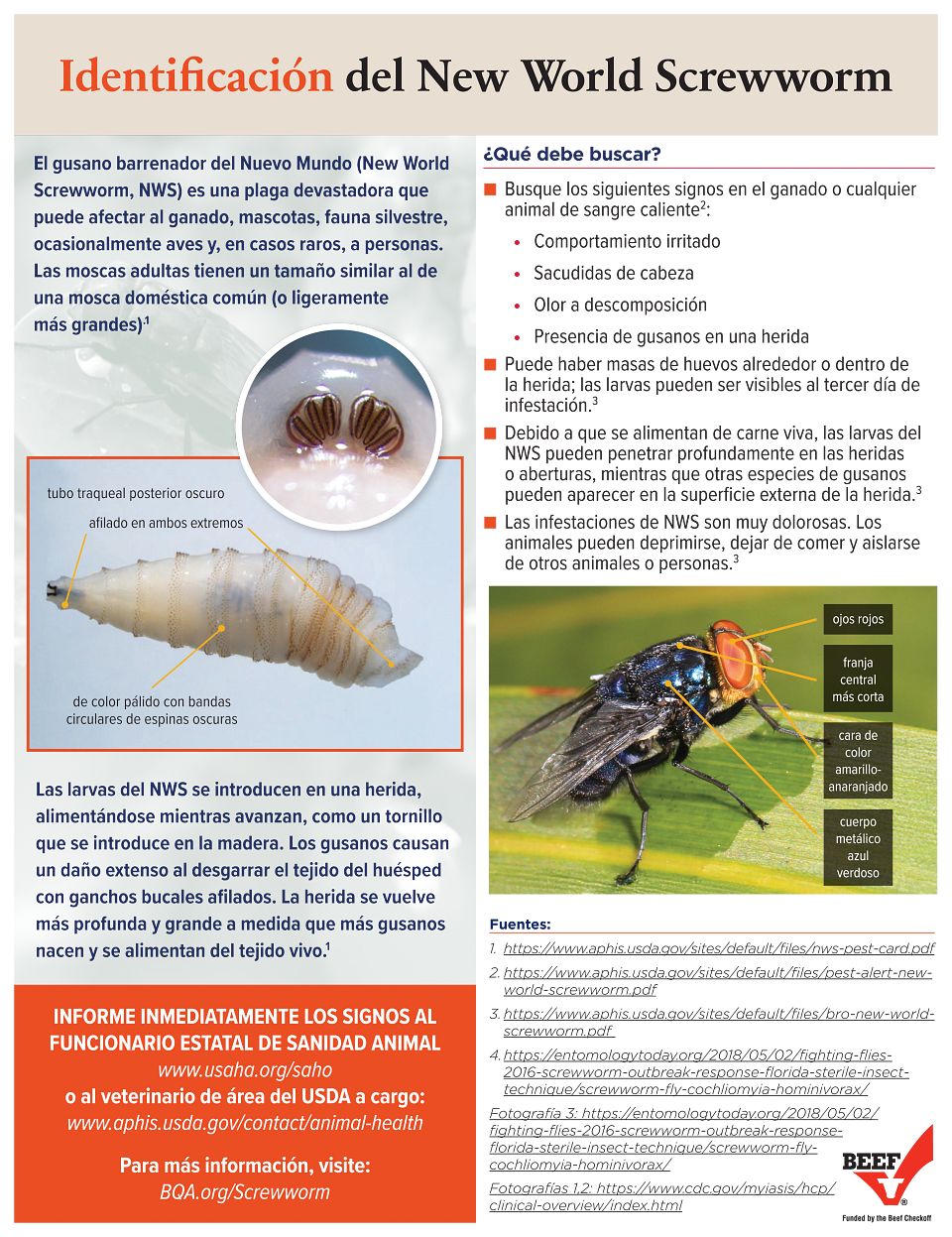
- Because they feed on live flesh, NWS maggots may burrow deep into wounds or openings, while other species of maggots may appear around the outer surface of the wound.4
- Screwworm infestations are very painful. Animals may become depressed, stop eating and separate themselves from other animals or people.4
What do I do if I suspect an animal has New World Screwworm?
How is New World Screwworm treated in animals?
- Treatment includes cleaning of the wound, removal of the larvae, and application of larvicides and measures to prevent secondary infections. Veterinary care is essential to avoid complications.5
- In areas where NWS is found, measures should be implemented to prevent animal wounds and avoid NWS myiasis.7
- For example, to the extent possible, eliminate or delay performing wounding procedures such as dehorning, branding, shearing, ear notching, tail docking and castration.7
- Untreated umbilical cords of newborn animals and foot lesions are commonly infested sites. Immediately treat all wounds with approved insecticides; it may also be prudent to follow up with precautionary spraying of animals with insecticide before transport.7
How does New World Screwworm spread?
- An adult screwworm fly can travel up to 125 miles before laying eggs in a wound.6
- Screwworms can also be transported by animals and people travelling from infested areas.6
What is the impact of New World Screwworm?
- NWS can threaten the livelihood of livestock producers. It can cause millions of dollars’ worth of production losses and economic damage.3
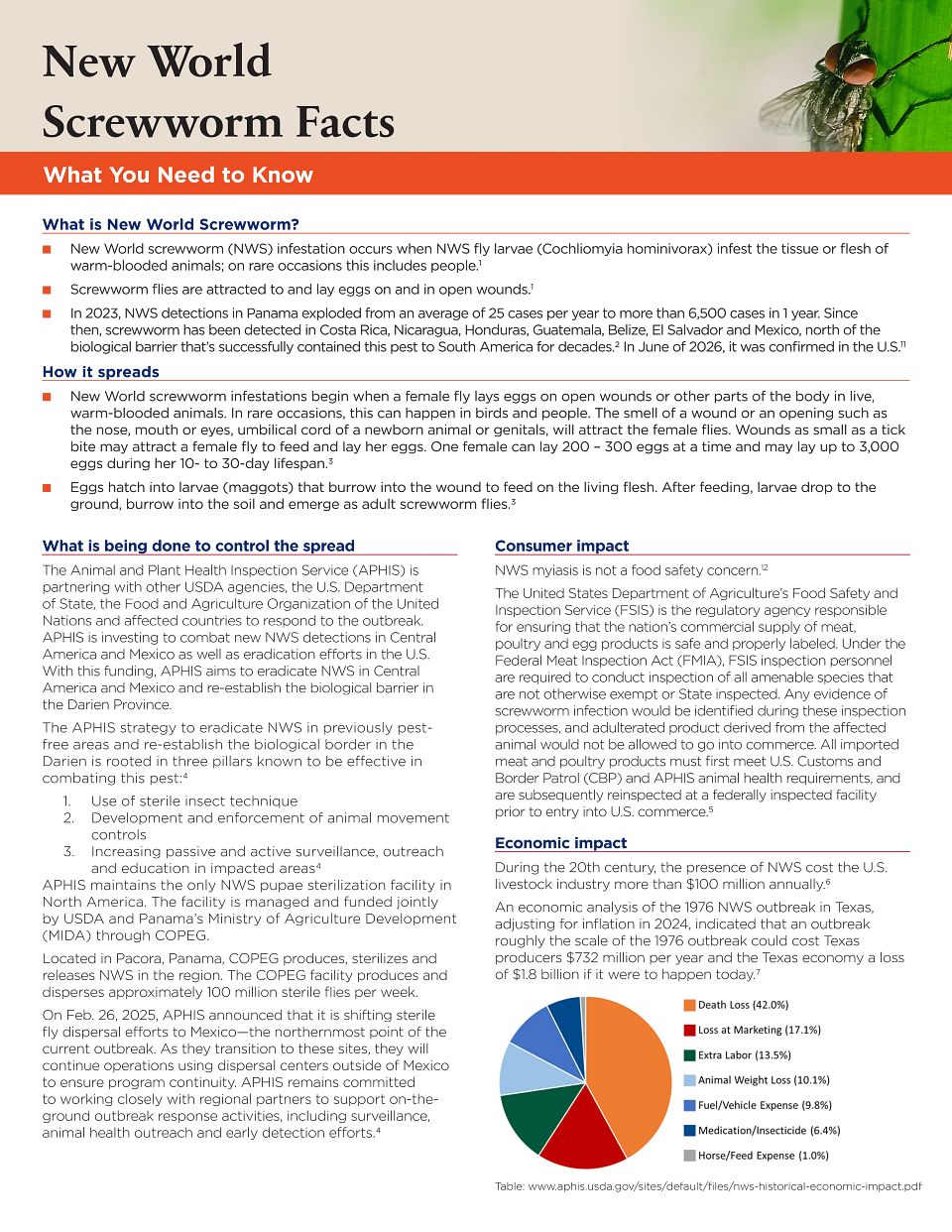
- During the 20th century, the presence of NWS cost the U.S. livestock industry more than $100 million annually.4
- Another incursion into the United States could cost millions of dollars from livestock losses, trade embargoes and eradication work.4
- Pets, livestock, wildlife and even humans may suffer and die from screwworm myiasis.4