Beef in a Healthy, Sustainable Diet
The Internet is flooded with trendy diets and conflicting advice on what a healthy diet is. The conversation has expanded beyond nutrition to consider whether the foods we eat are not only healthy but also sustainable – often leaving people confused about what is “good” and “bad” to eat.
To help cut through the confusion about what contributes to a healthy sustainable diet, Beef farmers and ranchers have worked using science and research to build a solid foundation. Using this research as a guide, we’ll look at how beef promotes health and helps prevent nutrient deficiencies1, and the ways in which cattle play a unique role in our food system by upcycling inedible plants to high-quality protein2 3. All of these factors can impact your choices at the meat case and on the menu.
Beef's Role in a Healthy Diet
Right now in America and other developed countries, it is common to be both overweight and, at the same time, undernourished. Why? We are surpassing recommended levels of calories, but we’re not balancing that with enough physical activity, and we’re not getting the recommended amounts of many important nutrients.
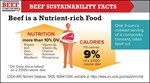
Beef – including steak, roasts and ground beef - offers a solution to this dilemma. It’s both delicious and it provides more nutrients in fewer calories than many other food choices. For example, a 3 oz serving of beef contributes over 50% of the daily value of protein and is also an excellent source of zinc, vitamins B6 and B12, niacin, and phosphorus and a good source of iron.14
Alternative Proteins: Better Than Real Beef?
It seems like every time you open a health or fitness magazine, a celebrity is promoting the newest power protein food. And for good reason — a healthy, balanced diet includes protein from a variety of sources. While alternative proteins are gaining attention and space in the fridge and on plates, their perceived health benefits may not outweigh the nutritional consequences of not including lean meats in your diet.
Current diet fads like to tout the proteins in plant-based products. We like black beans, quinoa, and edamame too, especially when they are paired with a great beef meal. But they are no substitute for beef's high-quality protein, which contains fewer calories and more nutrients.
A cooked 3 oz beef top sirloin steak averages about 156 calories while providing approximately 25 grams of protein4, which is nearly half of the recommended daily value. To get the same exact amount of protein (25 grams), you’d need to eat six tablespoons of peanut butter (amount customarily consumed is 2 Tbsp) or a whopping three cups of quinoa5 (amounts customarily consumed is about ¾ cup), for instance, which both also deliver a sizable amount of calories (564 calories for peanut butter; 666 calories for quinoa).
Sustainable Food System: Would Less Beef Be Better?
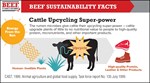
Cattle are beneficial in a sustainable food system because of their unique stomach structure, which allows them to eat and digest what we as humans can’t. In addition to the grasses they graze on for most of their lives, they can eat numerous other byproducts from plant-based food production, such as brewers grains, pea pulp, beet tops, potato peelings and sunflower hulls, which are all byproducts of human activities or other products, such as pea-protein burgers and meat crumbles. Instead of going to a landfill, cattle eat these “waste” products and turn them into a high-quality protein edible for human consumption.
Cattle also graze in areas where it’s impossible to grow crops, like the sand hills of Nebraska or the arid land of Nevada, taking those grasses and turning them into high quality protein, in places that could otherwise never be used to feed a growing population.
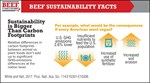
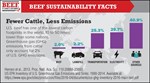
Many plant-based food advocates promote Meatless Mondays and vegan diets to reduce greenhouse gas emissions and lower their carbon footprint. However, research has demonstrated that removing all livestock and poultry from the U.S. food system would only reduce global greenhouse gas emissions by only 0.36 percent.6 And further, if all Americans participated in Meatless Monday, U.S. greenhouse gas emissions would perhaps be reduced by 0.37 percent.7 Removing beef from the diet would remove a high quality protein from diets, both in the U.S. and around the world.
Contributing to a Healthy Sustainable Diet
The bottom line is that beef is nourishing & part of a sustainable food system8 9 10, and most people are already eating beef within global dietary guidelines11. So, what can we all do to help make our diets heathier and more sustainable? There are three big opportunities that can make the biggest difference: waste less food, eat a balanced diet and improve the productivity of agriculture globally.
On average, 40% of all the food brought home in America goes uneaten, enough to fill a 90,000 seat Rose Bowl stadium every day, and that means food waste costs the average American family $2,500 annually12 13. If we wasted less beef, and less food in general, we would improve the environmental impact of our diets because that waste wouldn’t be emitting methane in a landfill. One great way to avoid food waste is using ingredients you already have to make a new meal or eating “plannedovers” to re-create leftovers.
We can also eat a balanced diet to contribute a healthy and sustainable food supply. We know that on average, 3 ounces of cooked beef provides 10 essential nutrients in about 170 calories including 25 grams of high quality protein, zinc, iron, and B vitamins.14 Beef packs a nutrient punch that can’t afford to be lost. By eating a variety of whole grains, fruits, vegetables, and lean proteins – and not wasting it – we can create a sustainable food system that will support a growing global population, so all people can thrive.
As we work together to build a healthier, more sustainable food supply for ourselves and future generations, our focus should be on changes that are science-based, practical and highly impactful, like reducing food waste, consuming balanced meals and improving global agricultural productivity.
- U.S. Department of Agriculture and U.S. Department of Health and Human Services. Dietary guidelines for Americans, 2020-2025. 9th Edition. Available at https://www.dietaryguidelines.gov/.
- U.S. Department of Agriculture, Agricultural Research Service, Nutrient Data Laboratory. FoodData Central. Available at fdc.nal.usda.gov (Beef composite, cooked - NDB Number: 13364).
- American Academy of Pediatrics Committee on Nutrition. Pediatric Nutrition, 8th Ed. Itasca, IL: American Academy of Pediatrics, 2019.
- Schwarzenberg SJ, Georgieff MK, Committee on Nutrition. Advocacy for improving nutrition in the first 1000 days to support childhood development and adult health. Pediatrics 2018;141(2).
- Gow ML, Ho M, Burrows TL, Baur LA, Stewart L, Hutchesson MJ, Cowell CT, Collins CE, Garnett SP. Impact of dietary macronutrient distribution on BMI and cardiometabolic outcomes in overweight and obese children and adolescents: a systematic review. Nutr Rev 2014;72(7):453-70.
- Hermoso M, Vucic V, Vollhardt C, Arsic A, Roman-Vinas B, Iglesia-Altaba I, Gurinovic M, Koletzko B. The effect of iron on cognitive development and function in infants, children and adolescents: a systematic review. Ann Nutr Metab 2011;59(2-4):154-65.
- Wallace TC, Blusztajn JK, Caudill MA, Klatt KC, Natker E, Zeisel SH, Zelman KM. Choline: The Underconsumed and Underappreciated Essential Nutrient. Nutr Today 2018;53(6):240-53.
- Lassi Z, Moin A, Bhutta Z. Nutrition in Middle Childhood and Adolescence. In: Bundy DAP, Silva Nd, Horton S, et al., editors. Child and Adolescent Health and Development. 3rd edition. Washington (DC): The International Bank for Reconstruction and Development / The World Bank; 2017 Nov 20. Chapter 11. Available from: https://www.ncbi.nlm.nih.gov/books/NBK525242/
- Norris SA, Frongillo EA, Black MM, Dong Y, Fall C, Lampl M, Liese AD, Naguib M, Prentice A, Rochat T, et al. Nutrition in adolescent growth and development. Lancet 2022;399(10320):172-84.
- Friedman AJ, Chen Z, Ford P, Johnson CA, Lopez AM, Shander A, Waters JH, van Wyck D. Iron deficiency anemia in women across the life span. J Womens Health (Larchmt) 2012;21(12):1282-9.
- Agarwal S, Fulgoni VL, 3rd. Contribution of beef to key nutrient intakes in American adults: an updated analysis with NHANES 2011-2018. Nutr Res 2022;105:105-12.
- Klurfeld DM. The whole food beef matrix is more than the sum of its parts. Crit Rev Food Sci Nutr 2022:1-9.
- Black MM. Micronutrient deficiencies and cognitive functioning. J Nutr 2003;133(11 Suppl 2):3927S-31S.
- Berge JM, Wall M, Hsueh TF, Fulkerson JA, Larson N, Neumark-Sztainer D. The protective role of family meals for youth obesity: 10-year longitudinal associations. J Pediatr 2015;166(2):296-301.
- Office of Disease Prevention and Health Promotion, Department of Health and Human Services. Help your child build a healthy eating routine. Available at https://www.dietaryguidelines.gov/sites/default/files/2021-12/DGA_KidsTeens_FactSheet-508c.pdf.
Subscribe to our newsletter so you don't miss the best recipes, cooking tips, and more.
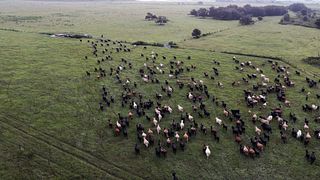
Ensuring Beef Safety
Everyone plays an important role in beef safety. From the cattle ranches across the U.S., to the meat processing plants, to your kitchen table, safety is pinnacle role in beef production.
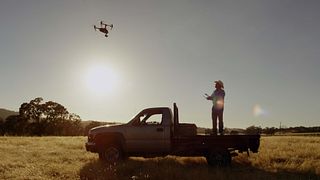
Animal Care and the Modern Rancher
Cattle ranchers have tools to keep their animals healthy and safe. These tools are science-based, regulated and good for the animal and consumer.
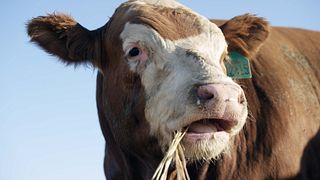
Beef Sustainability
To the beef community, sustainability comprises much more than environmental considerations. Today, a sustainable food supply balances efficient production with environmental, social and economic impacts.

Cattlemen and the Environment
Beef is produced using fewer resources than before. Ranchers work hard to feed a growing population, while reducing water use, care for the land, and protect the environment.